


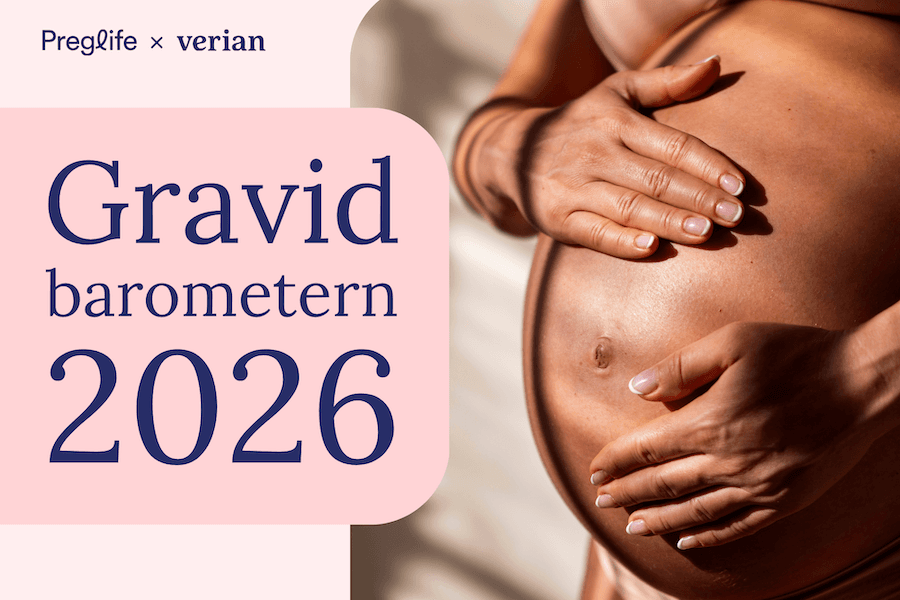


How are expectant parents affected by a world marked by uncertainty, instability and rapid societal change? This is the focus of this year’s edition of Gravidbarometern – Preglife’s annual report on what it is like to be pregnant in Sweden today.
This year’s theme, “Being Pregnant in Uncertain Times,” explores how the current global climate influences the experience of pregnancy and expectations for the future. The report examines how factors such as economic uncertainty, geopolitical instability, mental strain, and changing outlooks on the future affect pregnant women’s sense of security and their views on bringing children into the world today.
The purpose of the Pregnancy Barometer is to deepen understanding of the realities of pregnancy, identify where needs are greatest, and highlight areas where support and interventions can make a meaningful difference.
“Research from Sweden and other European countries shows that people, on average, would like to have more children than they ultimately do. Similar to the findings of Gravidbarometern, other studies show that having two or three children is the most common ideal family size. At the same time, actual fertility rates are now well below two children per woman.
This gap between desired and actual family size suggests that the low birth rates of recent years are not simply the result of a reduced desire to have children. Rather, many people face practical obstacles that limit their ability to realize their family aspirations. This points to an opportunity for policymakers: if these barriers can be identified and addressed, birth rates may increase while more people are able to create the family life they want.”
Erik Carlsson Researcher in Demography, Stockholm University Demography Unit
Highlights from the report
- 51% of respondents aged 16–29 are fairly or very concerned about their finances in relation to pregnancy and parental leave. The corresponding figures are 43% among those aged 30–37 and 39% among those aged 38–46.
- 64% report experiencing loneliness to some degree during pregnancy.
- 8% feel unable to speak openly about their pregnancy, even with people close to them.
- 37% of respondents aged 16–29 say they use AI services. The corresponding figures are 31% among those aged 30–37 and 21% among those aged 38–46.
- 33% say their mental health has worsened during pregnancy, while 21% report that it has improved.
- 33% believe that today’s children will have a more difficult future than their own generation.
- 93% of first-time parents report fairly or very high levels of engagement from their partner, compared with 84% among those who already have children. Partner involvement is therefore highest during a first pregnancy. 53% of respondents in the first trimester describe their partner as highly engaged, compared with 50% in the second trimester and 45% in the third trimester.
“A majority of these women feel that parenting has become more challenging than it used to be, which aligns with the high prevalence of so-called intensive parenting attitudes that I have identified in my research on Sweden.
The fact that 78% of women seek advice and information about their pregnancy online—more than from any other source—reflects how deeply digitalized everyday life has become and how experts today serve as close and constantly accessible sources of knowledge. This contributes to greater awareness, but also to a greater sense of responsibility that comes with knowing more.
We know that the growing volume of expert advice is one of the drivers behind the rise of intensive parenting, and here we see that this development begins already during pregnancy.”
Sunnee Billingsley Professor of Sociology, Stockholm University
About Preglife
Preglife is the app that makes pregnancy and early parenthood safer, easier and more enjoyable. The app offers a wide range of continuously updated content, including articles, videos, podcasts, exercises and relevant offers—always tailored to where users are in their pregnancy journey or life as a new parent.
Users can follow their pregnancy and their child’s development week by week while receiving practical guidance, inspiration and support for childbirth and the transition into parenthood.
Preglife is backed by an international network of midwives, physicians and medical experts who ensure that all content is evidence-based, medically reviewed and grounded in the latest research.
Preglife is used by 9 out of 10 pregnant women in Sweden and is built on the values of accessibility, inclusion and trust. Its mission is to empower every user to make informed decisions throughout pregnancy and parenthood.
For more information, please contact
Åsa Holstein CEO and Chief Midwife, Preglife
Mobile: +46 76 050 54 70 Email: asa.holstein@preglife.com