


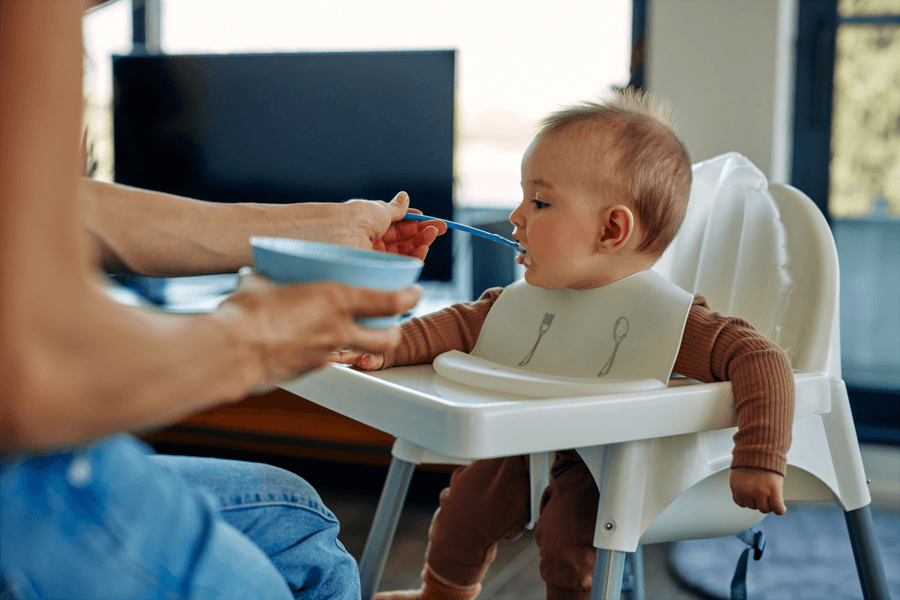


There isn’t enough research to say exactly how quickly babies become comfortable with solid foods. The age ranges described here are therefore based on clinical experience and public-health guidance rather than strict rules. Every baby develops at their own pace, and there’s no exact timeline that fits everyone. It’s normal if your baby wants to move faster—or more slowly.
Food is not only about nutrition, but also about comfort, security, and connection. As time goes on, mealtimes also become social moments. Introducing solid foods can sometimes feel challenging, and support is available through your child’s pediatrician or other healthcare providers. Around 6 months of age, most babies are developmentally ready to begin eating solid foods alongside breast milk or infant formula. Learning to eat solids is a gradual process.
Early on, the main goals are for your baby to:
- get used to new textures
- explore a wider range of flavours
- learn to eat from a spoon
- begin practising chewing movements
Continue breastfeeding or formula feeding as usual during this time. Breast milk and infant formula remain important sources of nutrition throughout the first year, so it’s completely fine if your baby takes things slowly with solid foods.
How to offer small portions of food
If your baby has already had tiny taste experiences, you can now slowly increase the amount. During the first few weeks, just a few teaspoons per meal are usually enough.
If your baby hasn’t had taste samples before, now is a good time to begin. Take small steps:
- Start with one or two teaspoons during the first few days
- Increase the amount gradually, following your baby’s cues
When feeding your baby:
- Check that the food is not too hot
- Use a small spoon, or allow your baby to self-feed soft, developmentally appropriate pieces
It’s common for babies to push food back out of their mouths at first. This usually doesn’t mean they dislike the food—it often reflects an immature swallowing pattern or unfamiliar textures. Solid foods are also less sweet than breast milk or formula, and new flavours often need repeated exposure before they’re accepted.
Some babies accept new foods quickly, while others need many exposures. You can encourage interest by eating the same food yourself and showing enjoyment. If your baby clearly refuses a food, it’s best to pause and try again after a few days rather than forcing it.
When is the best time to offer solid foods?
There’s no single “right” time of day. What matters most is that your baby is:
- Not extremely hungry
- Not overly full
- Not too tired
Some families prefer lunchtime, others dinner or a time in between. Try different times and see what works best for you and your baby.
Sources: